17話 二人の仙人
第2部 成道へ
第1章 苦行
17話 二人の仙人
アーラーラカーラーマ
その当時、現在のインドにあたる中部地方(マッジマデーサ)には宗教指導者がたくさんいた。それぞれの実践と教義の方法で、弟子たちに、かれらの庵で教えていた。
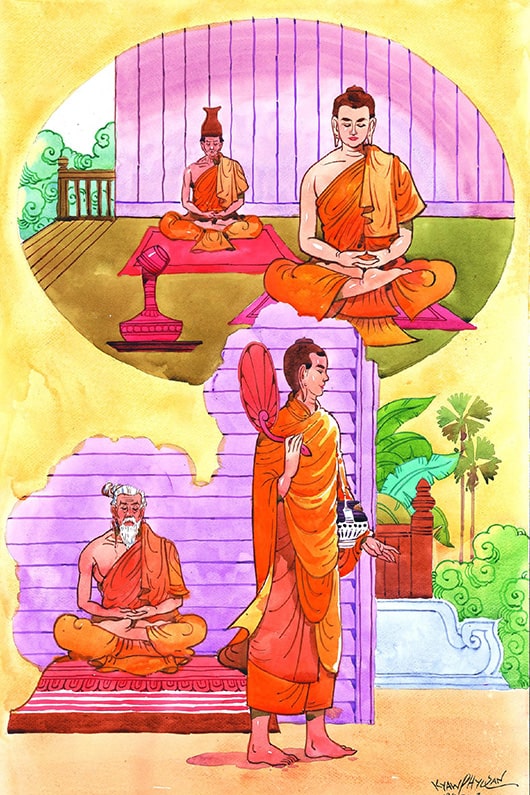
菩薩(ボーディサッタ)は崇高な平安である涅槃(ニッバーナ)という無上の境地をもとめる旅に出発した。パンダヴァ山からおりて、ヴェーサーリーの街に行った。そこには偉大な宗教指導者といわれていたアーラーラ・カーラーマが弟子たちとともに住んでいたのだ。かれは卓越した師で、とても尊敬されていた。いくつかの精神的な達成をなしとげ「無所有処(アーキンチャニャーヤタナ)」という精神集中の高度の段階に達した、と信じられていた。菩薩がその庵に着いて、かれに近づき「おお、友カーラーマよ、あなたの教えにしたがって聖なる修行生活をしたい、とわたしは望んでおります」といって許可をもとめた。
そこですぐにアーラーラ・カーラーマはこれを許し「あなたはここに滞在されてかまわない、おお、貴い友よ。この教えは、理解力があって実践する人なら時間がかからず、ありのままの知見をとおしてみずからを師としてみずからさとれ、そうすれば至福のうちにとどまることができます」と、心から励ました。
とびきり上等の知性である菩薩はたちまちアーラーラの教義に通じた。ほどなくかれの教えを智慧と確信をもって朗唱でき、復唱できるようになった。しかし、それによってでは最高の真理のさとりに至らなかった。そのとき、こんな考えが菩薩に浮かんだ。(アーラーラ・カーラーマはかれの教えを、ただの信念としてだけでは表明していないように見える。たしかにかれは、みずからありのままの知見をとおしてそれを得たので、その達成を持続しているにちがいないのだ)と。
そこで、かれはふたたび師のもとへ行って、きいた。
「友カーラーマよ、あなたはこの教えに、どこまで、みずからありのままの知見をとおしてさとり、到達されたのですか?」
これについてアーラーラ・カーラーマは、無所有処定(アーキンチャニャーヤタナジャーナ)(存在無の根底への精神的没入)にまで至る世間の色界(四段階)と無色界(三段階)の七段階の禅定すべての説明によってみずから実現した実践の智慧を教えた。そのとき、こんな考えが菩薩に起きた。(信、精進、念、定、智慧は、アーラーラ・カーラーマがもっているだけではなく、わたしもまた、これらの徳をもっている。みずからさとって、そこに至福のうちにとどまっている、というかれの教えを実現するために、もしかしてわたしは、努力してみたらどうであろうか!)
そこで菩薩は熱心にこころみ、二、三日のうちにさとり、ありのままの知見をとおして無所有処定の教えにまで到達し、そこに至福のうちにとどまったのだが、それによってでは最高の真理のさとりに到らなかった。
ふたたびアーラーラ・カーラーマのもとへ行って、きいた。
「おお、友カーラーマよ、みずからさとり、そこのなかに至福のうちにとどまっている、とあなたがいったこの教えは、これで全部、これですべて、なのですか?」
アーラーラ・カーラーマが、そうだ、とうなずくと、菩薩は、こう告げた。
「友よ、わたしはこの実践的なやりかたで熱心に精進して、教えをさとり、そこのなかに至福のうちにとどまっています」
アーラーラ・カーラーマは、このすぐれた弟子がさとりを達成したときいて、たいへん幸せだった。嫉妬やわがままのない真に貴い人間にふさわしく、かれは菩薩を公明正大に、こうほめた。
「われらは運がいい、友よ! われらがじつに運がいいのは、あなたのように鋭敏で、機敏で、たとえようのない知性をもった貴い同輩の行者がみつかったことです! だから、わたしがみずからありのままの知見をとおしてさとり、達成した教えを、あなたは、ありのままの知見をとおしてさとり、そこのなかに至福のうちにとどまっているのです。そして、みずからありのままの知見をとおしてさとり、達成した教えを、わたしは、そこのなかに至福のうちにとどまっているのです。だから、あなたはわたしが知っている教えを知っているのです。わたしはあなたが知っている教えを知っているのです。わたしがそうであるように、あなたもそうなのです。あなたがそうであるように、わたしもそうなのです。さあ、友よ! この集団をいっしょに指導しましょう!」
アーラーラ・カーラーマは弟子たちに、集まるように、といって、こう語りかけた。
「おお、弟子たちよ、わたしは七段階の禅定を達成した。同様に、この貴い同輩の行者も、そうだ。だから今後、おまえたちの半分はこの貴い同輩の行者の教えを受けるべきである。そして残りはわたしから教えを受けるべきである」
このようにアーラーラ・カーラーマは自分の弟子である菩薩を、かれ自身と同等に位置づけ、そして弟子の半分を託すことにしたのである。
菩薩はすぐに、この世でかれの達成したことの性質とその利益が来世ではどうなるのか、よく考えてみた。そしてこの世でかれの達成したことの性質とその利益と、無所有処で起きるはずの来世の無色界梵天の住まいでのかれの再生がわかってきた。そこで、こう考えた。(この教えは、冷静、煩悩の漸減、苦悩の滅尽、心のやすらぎ、あるがままの智慧、明智、涅槃にみちびかない)と。
菩薩は、かれの教えに満足できなくなった。精神的な高度の集中へみちびくだけで、生と死、老い、病いといったかれの心をつねに占めている問題への答えにはならないのだ。まず先に、みずからを完成させる、ということがないのに、行者の集団を指導する、という師が寛大にも申し出てくれたことには熱心になれなかった。最終的にかれは、アーラーラ・カーラーマに丁重にいとまごいをしたのである。
ウッダカ・ラーマプッタ
これとは別の有力な宗教指導者をみつけることは菩薩にはむずかしくなかった。なぜならその当時、中部地方(マッジマデーサ)にはおびただしい数の宗教指導者がいて、何世紀も前から発展させてきた伝統をもち、それを継承していく弟子たちをとおして、すっかり定着していた。こうした者らすべてが、聖なる修行生活を送ることによって精神的な向上に到達したい、という気にさせるのにふさわしい環境を提供していた。
菩薩はただちにヴェーサーリーをはなれ、歩いてマガダ国へ向かった。マヒー川を渡り、わずかな道のりのあと、川岸にある別の庵に着いた。その庵は、ウッダカ・ラーマプッタ(訳注:パーリ語で「ラーマの息子ウッダカ」の意味)という名のたいへん尊敬されている宗教指導者が住み処にしていた。
菩薩は、かれのもとに近づき、教えにしたがって聖なる修行生活をしたい、と許可をもとめた。かれは喜んで弟子として受け入れた。それから、かれの教えを菩薩に詳しく説明して、菩薩もまた、聡明な人としてすぐに教えをさとり、幸福のうちに生きるであろう、と励ました。
それ以降、時をむだにすることなく、菩薩は教えと実践の過程を熱心に学んだ。きわめて聡明な人として、ほどなく教えをやすやすと会得した。しかし、それは最高の真理のさとりをもたらさない、とわかったのだ。だから、かれはウッダカのもとへ行って、こうきいた。
「おお、友よ、あなたの父のラーマは、この教えのどの程度までさとって、とどまっている、といったのですか?」
ウッダカは「わが父、達人ラーマは非想非非想処定(ネーヴァサンニャーナサンニャーヤタナジャーナ)(対象を想念する意識作用が、あるでもなく、ないでもない状態の根底への精神的没入)にまで到る世間の色界(四段階)と無色界(四段階)の八段階の禅定の達成をみずからさとっていたのです」と、答えた。
ウッダカ自身はまだ、非想非非想処定までの高度の集中はさとっていなかった。幸運なことに、かれの父が死去する前に、その達成への実践的な知識を受け継いでいたのである。そこで、父のラーマから教わったことを菩薩に説明した。
冥想のやりかたにはっきり確信をもっていた菩薩は、最高の努力をして気づき、集中と智慧を実践に注ぎこんだ。いくらもたたず、かれは世間の禅定の最高段階である第八段階の非想非非想処定をさとった。
聡明な弟子が達成した、ときいたウッダカは歓喜の叫び声をあげて、ひたむきに菩薩にこう頼んだ。
「われらは幸福です、友よ! われらがじつに幸福なのは、このように鋭敏で、機敏で、たとえようのない知性をもった貴い同輩の行者と会えたことです! ラーマが知っている教えをあなたは知っている。あなたが知っている教えをラーマは知っている。ラーマがそうであるように、あなたもそうなのです。あなたがそうであるように、ラーマもそうなのです。さあ、友よ! これからはあなたがこの行者の集団を指導するべきです」
このように菩薩の前の師アーラーマとはちがって、ウッダカは菩薩を尊重して師となるように頼みこみ、しかも弟子すべてを任せる、とまで言ったのである。
しかしながら菩薩はすぐに、かれの達成は大望したことではない、とわかった。この達成によってでは非想非非想処定で起きるはずの来世の無色界梵天の住まいに再生するだけで、究極の目標は、はるか先なのだ。かれの心からの大望は、かれが学んだものの大望よりはるかに高いものだった。いまや、かれが探していることを教えてくれる者はいない、とわかったのである。最高の真理である涅槃に達するのには誰も頼れる者がいない、とわかったのだ。世間の禅定で達したものには満足できず、指導してもらったことすべてと、便宜をはかってもらったこと、尊重してもらったことへの満足を表明したあと、ウッダカ・ラーマプッタの庵を去った。
※ 画像やテキストの無断使用はご遠慮ください。/ All rights reserved.
Episode 17 Āḷāra Kālāma AND Uddaka Rāmaputta, THE TWO TEACHERS
Āḷāra Kālāma
At that time, in Majjhimadesa (Middle Country or India nowadays) there were many religious teachers. Each taught their own ways of practices and doctrines to their disciples in their hermitages. The Bodhisatta set out on his journey in quest of the supreme state of sublime peace—Nibbāna. He descended from the Paṇḍava Hill and went to the City of Vesālī, where a great religious teacher, Āḷāra Kālāma, lived with his pupils.
Āḷāra Kālāma was a distinguished teacher and was highly respected. He was believed to have attained several spiritual achievements up to the high state of concentration called “ākiñcaññāyatana”. When the Bodhisatta reached Āḷāra Kālāma’s hermitage, he approached him and made a request saying: “O friend Kālāma, I wish to lead a holy life in this dispensation of yours.”
Thereupon, Āḷāra Kālāma gave his permission and sincerely encouraged him: “You may stay here, O noble friend. This teaching is such that an intelligent practising person in no long time can realise through direct knowledge what his own teacher knows and dwells in blissfully.”
The Bodhisatta, being a man of superb intelligence, soon learned Āḷāra’s doctrine. And before long, he could recite and rehearse his teaching with knowledge and assurance, but it brought him to no realisation of the highest Truth.
Then, there came to him the thought: “It does not appear that Āḷāra Kālāma declares his teaching through mere faith; surely he must be one who has himself gained and realised it through direct knowledge and abides in the attainments thereof.” So he approached his teacher again and asked: “How far, friend Kālāma, that you yourself have realised and attained this teaching through direct knowledge?”
Upon this, Āḷāra Kālāma made known to him the practical knowledge that he had himself realised by giving a full account of the seven mundane attainments up to the ākiñcaññāyatana jhāna (the mental absorption of the base of Nothingness).
Then it occurred to the Bodhisatta: “It is not only Āḷāra Kālāma that has faith, energy, mindfulness, concentration, and wisdom, but I, too, possess these virtues. What if I strive to realise the teaching which he says he himself has realised and dwelt in its attainment blissfully!” Thus, he strived strenuously, and within two or three days he realised and attained the teaching through direct knowledge up to the ākiñcaññāyatana jhāna and dwelt in it blissfully, but it brought him no realisation of the highest Truth.
Again, he approached Āḷāra Kālāma and inquired: “O friend Kālāma, is this the full extent of this teaching of which you say that you yourself have realised through direct knowledge and dwelt blissfully therein?” When Āḷāra Kālāma replied affirmatively, the Bodhisatta informed him thus: “Friend, having put my strenuous effort through this practical course, I also have realised thus far in this teaching
and dwelt blissfully therein.”
Āḷāra Kālāma was very happy to hear the achievement of his distinguished disciple. Befitting a true noble person without envy and selfishness, he openly praised the Bodhisatta thus: “We are fortunate, friend! We are indeed fortunate to have found a venerable fellow ascetic with sharp, quick and incomparable intelligence like you! So, the teaching that I myself have realised and attained through direct knowledge, have you yourself realised through your direct knowledge
and dwelt blissfully therein. And the teaching that you yourself have realised and attained through direct knowledge, have I myself realised through direct knowledge and dwelt blissfully therein. So, you know the teaching that I know; I know the teaching that you know. As I am, so are you; as you are, so am I. Come, friend! Let us now lead this community together!” Āḷāra Kālāma then asked his disciples to assemble
and said: “O disciples, I have gained the seven mundane attainments, so has this noble fellow ascetic. So from now on, half of you should take instruction from this noble fellow ascetic; and the rest should take instruction from me.” Thus, Āḷāra Kālāma placed the Bodhisatta, his pupil, on an equal footing with himself and entrusted half of his disciples to him.
The Bodhisatta soon reflected on the nature and benefits of his attainments in the present life and what would be derived therefrom in the next; and he came to know the nature and benefits of his attainments in this present life and his rebirth that would take place in the Ākiñcaññāyatana Immaterial Brahmā abode in the next. Thereupon, he thought: “This teaching does not lead to dispassion, to fading of
lust, to cessation of sufferings, to peace of mind, to direct knowledge, to Enlightenment, and to Nibbāna.”
The Bodhisatta became dissatisfied with the teaching, which only led to a high degree of mental concentration, but did not provide the answer to the problems of life and death, old age and sickness that had constantly occupied his mind. He was not eager to lead the community of ascetics as offered by his generous teacher, without first perfecting himself. Finally, he politely took his leave from his teacher, Āḷāra Kālāma.
Uddaka Rāmaputta
It was not difficult for the Bodhisatta to find another religious teacher more competent than the previous one, since at that time in Majjhimadesa, there were numerous religious teachers with their own traditions which had developed centuries ago and which were well established through their successive disciples. All these provided a suitable environment for those who were inclined to reach spiritual
advancement by leading a holy life.
The Bodhisatta immediately departed from Vesālī and walked towards the Magadha Country. Having crossed the Mahī River, after some short distance he reached another hermitage on the river bank. The hermitage was led by a highly respected religious teacher named Uddaka Rāmaputta (Uddaka, the son of Rāma).
The Bodhisatta approached him and expressed his desire to lead a holy life in his dispensation. Uddaka was pleased to accept him as his disciple. He then expounded his teaching and encouraged the Bodhisatta that being an intelligent, person he, too, would soon realise the teaching and live in happiness.
Thereafter, without wasting his time, the Bodhisatta devotedly learned the teaching and the course of practice. Being a highly intelligent person, before long he could easily master the teaching.
But he found that it did not bring him to the realisation of the highest Truth. So he came to Uddaka and asked: “O friend, to what extent did your father Rāma say that he himself dwelt realising this teaching?”
Uddaka replied: “My father, Rāma the Master, had himself realised the eight mundane attainments up to the extent of the n’eva saññā n’āsaññāyatana jhāna (the mental absorption of the base of Neither Perception Nor Non-Perception).”
Uddaka had not yet himself realised the advanced concentration up to the n’eva saññā n’āsaññāyatana jhāna. Fortunately, before his father’s demise he had inherited the practical knowledge to attain it. He then explained what had been taught by his father, Rāma, to the Bodhisatta.
The Bodhisatta, who had firm faith in the meditation technique, put forth his utmost effort, mindfulness, concentration and wisdom into the practice. In a short time, he realised the eight mundane attainments up to the n’eva saññā n’āsaññāyatana jhāna, the highest state of worldly concentration.
Having heard the achievement of his intelligent disciple, Uddaka exclaimed his delight and invited the Bodhisatta thus: “We are happy, friend! We are indeed happy to see such a venerable fellow ascetic with sharp, quick and incomparable intelligence like you! The teaching that Rāma knew, you know; the teaching that you know, Rāma knew. As Rāma was, so are you; as you are, so was Rāma. Come, friend,
henceforth you should lead this community of ascetics.” Thus, unlike the Bodhisatta’s previous teacher, Uddaka honoured him by inviting him to be their teacher and to take full charge of all the disciples.
However, the Bodhisatta soon knew that his attainment was not what he aspired for. By this attainment, he would only be reborn in the N’eva Saññā N’āsaññāyatana Immaterial-Brahmā abode, but his ultimate goal was far ahead. He realised that his spiritual aspiration was far higher than the aspiration of those under whom he had learned. Now, he realised that no one was capable to teach him what he was searching
for. He knew that he could no longer depend on others to attain the highest Truth, Nibbāna. Unsatisfied with his mundane achievement, he left Uddaka Rāmaputta’s hermitage after expressing his gratitude for all the guidance, the facilities and the honour he was given.
※ 画像やテキストの無断使用はご遠慮ください。/ All rights reserved.
アシン・クサラダンマ長老
1966年11月21日、インドネシア中部のジャワ州テマングン生まれ。中国系インドネシア人。テマングンは近くに3000メートル級の山々が聳え、山々に囲まれた小さな町。世界遺産のボロブドゥール寺院やディエン高原など観光地にも2,3時間で行ける比較的涼しい土地という。インドネシア・バンドゥンのパラヤンガン大学経済学部(経営学専攻)卒業後、首都ジャカルタのプラセトエイヤ・モレヤ経済ビジネス・スクールで財政学を修め、修士号を取得して卒業後、2年弱、民間企業勤務。1998年インドネシア・テーラワーダ(上座)仏教サンガで沙弥出家し、見習い僧に。詳しく見る
奥田 昭則
1949年徳島県生まれ。日本テーラワーダ仏教協会会員。東京大学仏文科卒。毎日新聞記者として奈良、広島、神戸の各支局、大阪本社の社会部、学芸部、神戸支局編集委員などを経て大阪本社編集局編集委員。1982年の1年間米国の地方紙で研修遊学。2017年ミャンマーに渡り、比丘出家。詳しく見る

※ 画像やテキストの無断使用はご遠慮ください。
All rights reserved.