15話 髮を切る
第1部 出家まで
第5章 出家
15話 髮を切る
白馬カンタカにまたがり、菩薩はとびきりの速さで駆けた。しかし、いくらか距離を稼いだあと、カピラヴァットゥの都をひとめ見ておこう、という考えが浮かんだ。馬を止め、ふり返り、これを都の見おさめとした。カンタカが止まったところは聖なる場所(霊場(チェーティア))として「カンタカふり返り(ニヴァッタ)のチェーティア」と呼ばれる聖廟が、のちに立てられた。菩薩はこのあとも旅をつづけ、釈迦、コーリヤ、マッラの三国を通りすぎ、ひと晚で三十ヨージャナ(訳注:約四百㌔前後。ヨージャナは当時の長さの単位)進んだ。最後に着いたのはアノーマー川の岸辺だった。川のほとりで馬を止め、御者にきいた。
「チャンナ、この川は何という名前なんだ?」
「アノーマー川でございます、殿下」
菩薩は、川の名前の意味するものが、自分の出家の意味を証明するものであるかのように思って、一つの願いごとをした。「わが出家は、劣ったものではなく、勝れたものでありますように」と。アノーマーとは劣っていない、つまり勝れた至高のもの、という意味だからである。それから菩薩はカンタカの腹をかかとで蹴って、川を跳びこすように、と命じた。するとカンタカはただちに、はるか向こうの対岸へ、ひとっ跳びの大跳躍をした。
夜明けだった。川岸の白い砂が、朝の陽の光でキラキラ輝いている。風が吹いて、新鮮な朝の空気が流れていた。草や茂み、木々の葉は夜露にぬれたままだ。目覚めたばかりの鳥たちが巣から起きだしてチュンチュン、チッチッチッと騒がしくさえずり、まるでみんなに、一日が始まったよ、と告げているかのようであった。
菩薩はカンタカの背から降りた。白い砂地の上に立って、チャンナに話しかけた。
「わが友チャンナよ、目的地にわたしは着いた。これから僧になるのだ。どうかカンタカをつれて、わたしの冠など、王家の徽章をカピラヴァットゥへ持って帰っておくれ!」
「殿下、こどものときから、いつもずっと、わたしはお供して参りました。わたしも殿下と同じく、僧にならせてください。そうしたら、いつまでもお供できますから!」と、チャンナは懇願した。
「だめだ、チャンナ。おまえが僧になるのをわたしは許さない。ともかくカピラヴァットゥへ帰れ!」と菩薩は許さず、このあとカンタカと装身具をチャンナに託した。
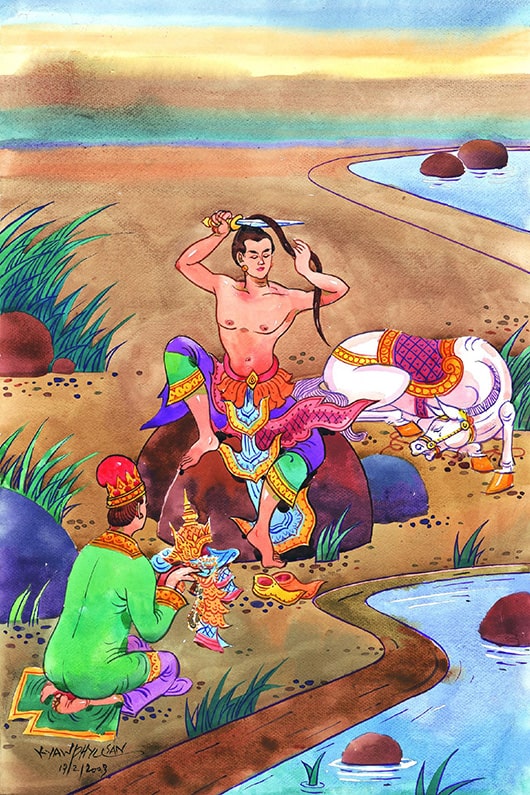
それから、菩薩は黄金の剣を右手にもち、左手で自分の長い髪をつかんだ。いっきに、それを切り落とし、その髻と冠を結んだ。残った頭髪は指二本の幅の長さで、もはやそのままで生涯の終わりまで伸びなかった。このとき厳粛な決意を固めた。「もし、わたしがブッダになる定めなら、この髪は空中に浮かんだままになれ! さもなければ、地上に落下させよ!」と。そして髪を上空に投げた。驚くべきことに、空中に浮かんだままになったのである。
髻がついた冠が空中に浮かんでいるのを見た神々の王である帝釈天(サッカ)は、ただちにそれを宝石箱に収納し、その宝石箱を安置するため「髻の宝珠(チューラーマニ)のチェーティア」という聖廟を建立したのであった。
ふたたび菩薩は、こんなことを思いめぐらせていた。いま着ている王家の衣装は、修行者にはふさわしくないのではないかと。ガティカーラ梵天がそんな菩薩を見ていた。ガティカーラ梵天は、過去七仏の第六でゴータマ仏の一つ前のブッダであるカッサパ仏の生存中に、たまたま菩薩と親友だったのだが、このまさに大出離、気高く貴い出家の日に、天界から見ていたのである。ガティカーラ梵天の住まいは天上の色界十六天最高位の有頂天(色究竟天)であるアカニッタ梵天だが、そこから人間界に降下して、旧友の王子のために、僧に必要な八つ(アッタ)の要具(パリッカーラ)をもってきて提供してくれたのだった。八つの要具とは、大衣(サンガーティ)、上衣(ウッタラーサンガ)、内衣(アンタラワーサカ)、鉢(パッタ)、剃刀(ヴァーシ)、針(スーチ)、帯(カーヤバンダナ)、水こし袋(パリッサーワナ)である。
阿羅漢果(アラハッタパラ)の聖者のしるしともいえるきちんとした修行者の衣をまとって、菩薩はこれまで着ていた王家の衣装を空中へ放り投げた。それをガティカーラ梵天がつかみ、収納のため「衣服(ドゥッサ)のチェーティア」と呼ばれる聖廟をアカニッタ梵天の住まいに立てた。
ひとりの僧となって、菩薩はチャンナに、ただちにカピラヴァットゥに帰れ、と指示した。
「チャンナよ、お別れのときがきた。父王スッドーダナ、母のマハーパジャーパティー・ゴータミー妃、妻のヤソーダラー妃に、わたしからのお別れのあいさつを届け、わたしは元気であると伝えておくれ!」
チャンナはうやうやしく菩薩(ボーディサッタ)にお辞儀して、菩薩(ボーディサッタ)の装身具をもち、カンタカをつれて別れた。だがチャンナが行こうとしても、カンタカは拒んだ。この馬は、地面に脚を踏んばって突っ立ったままであった。これからはもうわが主人に会う機会がないのだ、と思うと、立ち去りがたかったのである。菩薩は馬に近づき、とてもやさしく頭をなでた。そして、こう諭(さと)した。
「カンタカ、チャンナといっしょに行っておくれ! もう、わたしを待つな! わたしは一切知者になってから、またやって来るであろう」
それからチャンナとカンタカの両方とも、顔に涙しながら去った。しばらく行ったあと、カンタカが止まり、菩薩(ボーディサッタ)の見おさめをしようとふり返った。さらにいくらか距離を稼ぐと、もう互いに見えなくなった。カンタカは嘆きつづけ、あれほど慕っていた菩薩(ボーディサッタ)との別離の深い悲しみに耐えられなくなった。かくしてカンタカは失意の傷心で亡くなった。ふたりの親しい友との別れで、チャンナはカピラヴァットゥへの帰路を、声を上げて泣きながら歩みつづけた。
シッダッタ・ゴータマはこのとき二十九歳、若く凜々しく、力にあふれ、ただひとりの釈迦国の世継ぎであった釈迦族の王子は、この世の生活の贅沢と娯楽すべてからはなれ、人間社会のために、生老病死が引き起こす苦を乗りこえる道を探すため、僧になった。このとき以来、托鉢して命をささえ、樹木の下やひとけのない洞窟で眠って疲れをいやし、気高く貴い探求にみずからをささげる家なき遍歴をした。「偉大な出家」として知られていることは、このように起きたのである。
※ 画像やテキストの無断使用はご遠慮ください。/ All rights reserved.
Episode 15. CUTTING OFF THE HAIR
The Bodhisatta rode the white steed Kanthaka, which was running at a great speed. But after covering some distance, a thought of taking a view of Kapilavatthu arose in his mind. He stopped his royal horse and turned round, taking a final look at the city. A holy shrine (cetiya) called Kanthakanivatta Cetiya had since been erected at the very place where the royal horse Kanthaka halted. After that, the Bodhisatta
continued his journey passing through the three kingdoms of Sākya, Koliya and Malla, covering a distance of thirty yojanas in one whole night. He finally arrived at the bank of the Anomā River.
He stopped his royal horse Kanthaka at the edge of the river and asked his charioteer: “Channa, what is the name of this river?”
“This river is called Anomā, Your Majesty,” Channa replied.
The Bodhisatta reflected the meaning of the river’s name as a token of his renunciation and made a wish: “May my renunciation not be inferior but a superior one.” (Anomā means ‘not inferior’). Then, the Bodhisatta ordered Kanthaka to cross the river by striking his belly with the heel, and Kanthaka immediately made a great jump to the farther bank of the river.
It was dawn. The white sand on the bank of the river was gleaming like pearls under the morning sunray. The wind was blowing fresh morning air; the grass, bushes and leaves of trees were still wet with night dews while the birds just awake from their night rest were chirping and twittering noisily as if they were telling everyone that the day had started. The Bodhisatta dismounted from the back of Kanthaka. While standing on the white sandbank, he addressed Channa: “My friend Channa, I have arrived at my destination and I will become a monk. Please, take the horse Kanthaka together with my royal regalia and return to Kapilavatthu!”
“Your Majesty, I have always accompanied you since our childhood. Please let me be a monk like you, so that I can always accompany you!” Channa pleaded.
“No, Channa. You do not have my permission to become a monk. Just go back to Kapilavatthu!” forbade the Bodhisatta, who afterwards handed over his royal steed Kanthaka and the ornaments to Channa.
Thereafter, the Bodhisatta took out his golden sword with his right hand, and grabbed his long hair by his left hand. With a single stroke, he cut off his long hair, which he then he held together with his royal diadem. The length of his hair remained two fingers’ breadth and it did not grow any longer till the end of his life. Then, he made a solemn resolution: “If I were destined to become a Buddha, let this hair stay in the air! Else, let it fall to the ground!” and threw the hair up. It marvelously remained in the air.
Sakka, the king of devas, who saw the Bodhisatta’s hair with the royal diadem hanging in the air, immediately received it with a jewel casket. He erected a shrine named Cūḷāmaṇi Cetiya for enshrining it.
Again, the Bodhisatta reflected that the royal clothes he was wearing were improper for an ascetic. Brahmā Ghaṭikāra, who happened to be an old friend in the lifetime of the Buddha Kassapa, saw the Bodhisatta was going forth on noble renunciation that very day. Then from his Akaniṭṭha-Brahmā abode, he came down to the human world taking the requisites of a monk for his old friend, the Bodhisatta prince. He offered the eight requisites (aṭṭhaparikkhāra) to the Bodhisatta: a
double robe (saṅghāṭi), an upper robe (uttarāsaṅga), a lower robe (antaravāsaka), an alms-bowl (patta), an adze (vāsi), a needle (sūci), a waistband (kāyabandhana), and a water-strainer (parissāvana).
Having properly put on the robeswhich may be termed as the banner of Arahatta Phalathe Bodhisatta threw his royal garments up into the sky. Brahmā Ghaṭikāra seized them. He then he erected a shrine, called Dussa Cetiya, for enshrining them in the Akaniṭṭha-Brahmā abode.
Having become a monk, the Bodhisatta instructed Channa to immediately go back to Kapilavatthu: “Channa, the time has come for us to separate. Send my respect to my father King Suddhodana, my mother Queen Mahāpajāpatī Gotamī and Princess Yasodharā, and convey to them that I am in good health!”
Channa paid obeisance respectfully to the Bodhisatta, took the Bodhisatta’s ornaments along with the royal steed Kanthaka, and departed. Channa was about to go, however Kanthaka refused to. The horse stood firmly on the ground thinking that from then on he would not have the opportunity to see his master any longer. The Bodhisatta approached the horse, rubbed his head very softly and persuaded: “Kanthaka, please go with Channa! Do not wait for me any more! I will come back after I gain omniscience.”
Then, both Channa and Kanthaka departed with tears rolling down on their faces. After a distance, Kanthaka stopped and turned around to have a last look at the Bodhisatta. After they had covered some distance and they could not see one another anymore, Kanthaka, who had been lamenting since the departure, could not bear his deep grief of separation from the Bodhisatta, whom he loved so much. Thus, he died
broken-hearted. Being separated from his two close friends, Channa continued his way home to Kapilavatthu, weeping and crying.
At the age of twenty-nine, the Sākyan prince Siddhattha Gotama, young, handsome and full of power, the single inheritor of the Sākya Kingdom, had left all the luxuries and enjoyments of worldly life to become a monk for the sake of humanity, to seek the way to overcome suffering caused by birth, aging, sickness and death. From then onwards, he wandered as a homeless one, supporting his life by
collecting alms-food, releasing his tiredness by sleeping under a tree or in a lonely cave, and fully dedicating himself to his noble quest. Thus came about what is known as “The Great Renunciation”.
※ 画像やテキストの無断使用はご遠慮ください。/ All rights reserved.
アシン・クサラダンマ長老
1966年11月21日、インドネシア中部のジャワ州テマングン生まれ。中国系インドネシア人。テマングンは近くに3000メートル級の山々が聳え、山々に囲まれた小さな町。世界遺産のボロブドゥール寺院やディエン高原など観光地にも2,3時間で行ける比較的涼しい土地という。インドネシア・バンドゥンのパラヤンガン大学経済学部(経営学専攻)卒業後、首都ジャカルタのプラセトエイヤ・モレヤ経済ビジネス・スクールで財政学を修め、修士号を取得して卒業後、2年弱、民間企業勤務。1998年インドネシア・テーラワーダ(上座)仏教サンガで沙弥出家し、見習い僧に。詳しく見る
奥田 昭則
1949年徳島県生まれ。日本テーラワーダ仏教協会会員。東京大学仏文科卒。毎日新聞記者として奈良、広島、神戸の各支局、大阪本社の社会部、学芸部、神戸支局編集委員などを経て大阪本社編集局編集委員。1982年の1年間米国の地方紙で研修遊学。2017年ミャンマーに渡り、比丘出家。詳しく見る
※ 画像やテキストの無断使用はご遠慮ください。
All rights reserved.